Blueprint by ENGYN · In beta testing
See how everything connects.
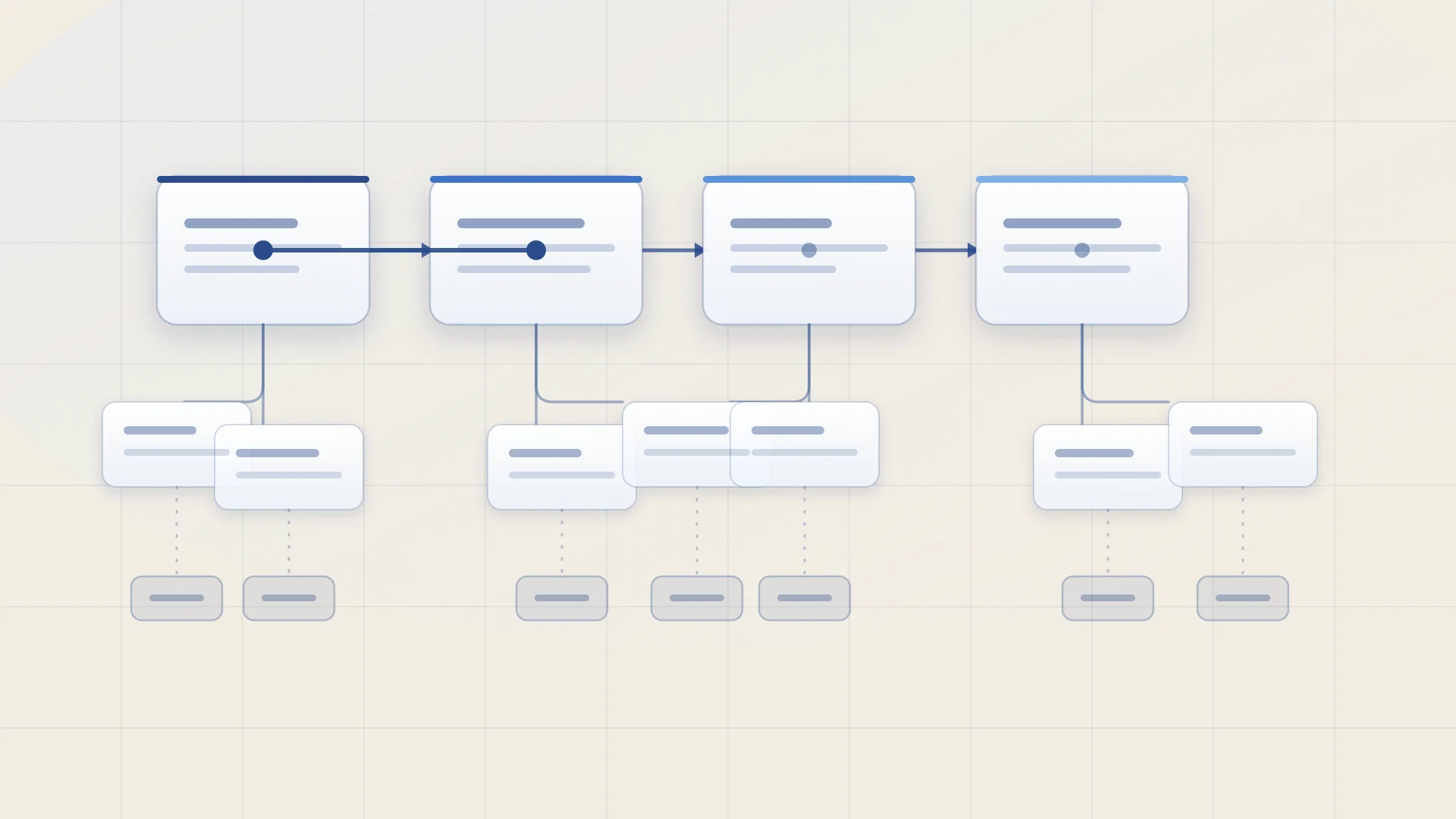
Blueprint by ENGYN turns complex business processes, product journeys, systems and data into connected visual blueprints. Start with the big picture, explore the detail and ask questions that reveal the relationships behind it.
- Map
- Explore
- Explain
- Compare
- Understand
- Stage
- In testing
- Portfolio bay
- Bay 05
- Focus area
- Venture Architecture & Product Design
- Part of
- The Collective Foundry
The problem
Complexity is easy to create. Understanding it is harder.
Business processes, product screens, technical documentation and data definitions often sit in separate places. Teams struggle to explain how they connect, where a change might matter and which information supports the answer. A diagram alone is not enough when the underlying story remains unclear.
Who it's for
Business leaders, product teams, analysts, architects and engineers who need a shared understanding of complex work.
The opportunity
A shared picture for business and technology.
Blueprint brings business context and technical detail into the same conversation. It is designed to help people explore a system at the level they need, without forcing every audience through the same dense technical view.
Why now
More connected systems need clearer explanations.
- 01
Business decisions increasingly depend on relationships across software, processes and data.
- 02
AI can help people navigate complexity, provided its explanations remain grounded in available sources.
- 03
Teams need to understand proposed changes before committing to them.
What it does
What Blueprint does.
Map the business and its technology
Connect business capabilities and processes with the screens, systems and data that support them.
Move from overview to detail
Begin with a readable parent view, then explore child views without losing the wider context.
Filter to the relevant connections
Focus an existing blueprint on the entities and relationships relevant to a particular area of work.
Ask for the journey to be explained
Turn a question into a focused visual explanation, showing the sequence, supporting details and available evidence.
Trace from input to outcome
Explore documented connections between inputs, processing, stored data and reporting. Show calculations and values when supported by source definitions or code; make missing evidence explicit.
Explore current and proposed change
Compare states and investigate potential downstream effects where the underlying relationships support that analysis.
What makes it innovative
More than a diagram. A way to understand the journey.
Context at every level
Move between overview and supporting detail without losing the wider picture.
Questions become visual explanations
A focused answer is drawn as a readable sequence, making complex relationships easier to follow.
Evidence stays visible
Documented facts, proposed connections and unknowns are distinguished rather than blended.
The usual way
Separate documents and dense diagrams that require someone to reconstruct the story.
The foundry way
Connected views designed to explain the relevant journey and expose its supporting detail.
How it compares
Blueprint by ENGYN against the architecture and enterprise-modelling tools teams actually shortlist.
Every competitor cell below is drawn from that vendor's own official site on the date shown. Where a capability was not documented there, it is marked Not publicly verified rather than Not available — absence of evidence is not evidence of absence.
| Capability | Blueprint by ENGYN Beta — not yet generally available | IcePanel Paid plans as published | Eraser Paid plans (API and AI credits are plan-gated) | Lucidchart / Lucid AI Enterprise with AI enabled (Process Capture is beta and metered) | Miro Business / Enterprise (AI metered by credits) | Ardoq Enterprise platform | SAP LeanIX Application Portfolio Management plus Architecture & Road Map Planning |
|---|---|---|---|---|---|---|---|
| Mapping the landscape Business capability & process modelling Separates tools that model the business from tools that only model the software. | Included In beta Depth 4/5 · target 5/5 Capabilities and processes modelled; not enterprise portfolio governance | Not publicly verified Depth 1/5 Models software architecture (C4), not business capabilities | Not publicly verified Depth 1/5 | Advanced Shipped Depth 4/5 Process mapping is the core strength | Included Shipped Depth 3/5 Process and system diagrams on a collaborative canvas | Advanced Shipped Depth 5/5 Multi-level capability models and value streams | Advanced Shipped Depth 5/5 Applications mapped to the capabilities they support |
| Mapping the landscape Product screens mapped to the systems behind them The join most tools leave out: what a user actually touches, and what serves it. | Advanced In beta Depth 5/5 Screens joined to the systems and data behind them | Not publicly verified Depth 1/5 | Not publicly verified Depth 1/5 | Limited Shipped Depth 3/5 Screenshots attach to steps; the systems behind them are not modelled | Not publicly verified Depth 1/5 | Not publicly verified Depth 1/5 Applications are modelled; individual product screens are not | Not publicly verified Depth 1/5 |
| Mapping the landscape Input to calculation to stored result to report Whether a number can be followed back to where it came from. | Advanced In beta Depth 5/5 Input, calculation, stored result and report followed end to end | Not publicly verified Depth 1/5 | Limited Shipped Depth 2/5 ERDs from schema files; lineage through to reporting not documented | Not publicly verified Depth 1/5 | Not publicly verified Depth 1/5 | Not publicly verified Depth 2/5 | Not publicly verified Depth 2/5 |
| Moving through it Parent-to-child drill-down that keeps context Distinguishes a navigable model from a wall of boxes. | Advanced In beta Depth 5/5 Parent to child without losing the wider context | Advanced Shipped Depth 5/5 C4 levels, high to low, one model behind every diagram | Not publicly verified Depth 1/5 | Not publicly verified Depth 2/5 | Not publicly verified Depth 1/5 | Included Shipped Depth 4/5 Connected models across capability, application and technology layers | Included Shipped Depth 4/5 Capability hierarchy with inherited relations to child items |
| Moving through it Filter an existing model to the relevant connections Reusing one model per question, rather than drawing a new diagram each time. | Advanced In beta Depth 5/5 One model refocused per question rather than redrawn | Not publicly verified Depth 2/5 | Limited Shipped Depth 2/5 Scope a generation by folder or file path | Not publicly verified Depth 1/5 | Not publicly verified Depth 1/5 | Included Shipped Depth 4/5 | Included Shipped Depth 4/5 Filtering follows transitive capability relations |
| Question-led explanation A question answered as a focused visual journey Generating a diagram is common; explaining a specific path through an existing model is not. | Advanced In beta Depth 5/5 A question returns a focused visual journey through the existing model | Limited Shipped Depth 3/5 Flows are authored step sequences; model questions go through the MCP server | Included Shipped Depth 3/5 Prompt to diagram, with a repository as context | Included Shipped Depth 4/5 Process Agent builds and refines through conversation against retained context | Included Shipped Depth 3/5 Prompt to diagram; Sidekicks give contextual advice on the board | Included Shipped Depth 3/5 AI assistant for dependency and impact questions, human in the loop | Not publicly verified Depth 2/5 |
| Evidence & provenance Evidence beside the answer, unknowns made explicit Whether you can tell a documented fact from an inference. | Advanced In beta Depth 5/5 Documented facts, proposed connections and unknowns kept distinct | Limited Shipped Depth 2/5 Objects link out to real-world resources | Limited Shipped Depth 2/5 API responses name the repository files used | Limited Shipped Depth 2/5 Source recording and context frame stay with the diagram | Not publicly verified Depth 1/5 | Not publicly verified Depth 2/5 Traceability is described in vendor marketing terms | Not publicly verified Depth 2/5 |
| Change & comparison Current versus proposed state, and downstream effects Understanding a change before committing to it. | Included In beta Depth 3/5 · target 4/5 Current versus proposed compared; large-programme impact planning is not the target | Included Shipped Depth 3/5 Current and future designs | Not publicly verified Depth 1/5 | Not publicly verified Depth 1/5 | Not publicly verified Depth 1/5 | Advanced Shipped Depth 5/5 Branches simulate future state and compare options side by side | Advanced Shipped Depth 5/5 As-is versus to-be with classified impacts and differential views |
Who each tool is actually best for
- Blueprint by ENGYN Beta — not yet generally available
Teams who need to follow a business journey from a user action through the supporting logic, systems and data, and see the evidence behind each step. Built and in beta testing; not yet generally available.
Source: Product owner attestation — capabilities built, product in beta testing
- IcePanel Paid plans as published
Software architecture teams who want a C4 model with real drill-down and authored flows, kept consistent across diagrams.
Source: Diagramming — model-based philosophy, C4 hierarchy , Flows — step-by-step sequences through the model , Pricing — drill down from high to low level , MCP server — ask an LLM questions about the model
- Eraser Paid plans (API and AI credits are plan-gated)
Engineering teams who want architecture, sequence and ER diagrams generated from a prompt or straight from a repository, and kept current as code changes.
Source: Codebase diagrams — generated from a Git repository , AI diagrams — architecture, sequence, flowchart, ERD , Eraserbot — keeps diagrams current as the code changes
- Lucidchart / Lucid AI Enterprise with AI enabled (Process Capture is beta and metered)
Business and operations teams documenting how work is actually done, including turning a screen recording into a process diagram and a written SOP.
Source: Process Capture — screen recording to diagram and SOP , Lucid AI — Process Agent builds and refines from context
- Miro Business / Enterprise (AI metered by credits)
Workshops and collaborative design, where a diagram is one output of a wider working session rather than a maintained model.
Source: AI diagram generator — flowcharts, UML, ERD, process maps from a prompt , Software Architecture Sidekick — contextual advice on the board
- Ardoq Enterprise platform
Enterprise architecture teams modelling capabilities, applications and dependencies at organisational scale, with scenario branches for future state.
Source: Business capability modelling and realization metamodel , Modeling and roadmaps — branches, impact analysis, side-by-side options , Ardoq AI — dependency questions, impact analysis, human in the loop
- SAP LeanIX Application Portfolio Management plus Architecture & Road Map Planning
Large transformations where applications must be mapped to capabilities and the impact of a programme tracked against the landscape.
Source: Business Capability Map — applications mapped to the capabilities they support , Impacts — a transformation broken into classified changes , SAP LeanIX enterprise architecture documentation
Considered and excluded
- Port — Adjacent rather than a head-to-head alternative. Port documents software-catalog dependency graphs and natural-language querying of catalog data — strong for technical dependency exploration, but it is a developer-portal catalogue rather than a business-and-technology blueprint, so scoring it against business-journey rows would misrepresent what it sets out to do. Check current status
How this comparison is made
- Comparative claims follow ACCC guidance: they must be accurate, fair and supportable on reasonable grounds, judged on the overall impression rather than line by line.
- A competitor capability is only marked as present where its official site documents it. Where it was not documented, the status is “Not publicly verified” — not “Not available”. This is a desk review of published material, not a hands-on benchmark.
- Blueprint is built and in beta testing, on the product owner’s attestation of 11 October 2026 rather than a public release, and has not been independently verified. Its delivery chips read “In beta” throughout. It is scored on the same depth scale as every other column, including the two rows where a competitor scores higher.
- Depth scores (0–5) are our own analytical assessment of how deep a capability runs. They are not vendor-published figures, and they are separate from the evidence status beside them.
- A target depth states design intent and is published only for our own column. Blueprint carries one on the two rows where an incumbent is currently ahead, which is where the gap and the plan both live.
The approach
Start with the question. Keep the context.
Blueprint by ENGYN helps teams understand how their business and technology work together. It connects capabilities, processes, screens, systems and data in visual blueprints that move from a simple overview to the detail behind each relationship.
It is a product by ENGYN rather than a separate venture: Blueprint brings a visual understanding layer to ENGYN’s ambition for intelligent work.
The outcome: a shared picture business and technical teams can explore together, with the evidence behind each connection kept in view.
The outcome
Make complex decisions easier to discuss.
- A clearer shared understanding across business and technical teams.
- More focused conversations about how a system works.
- Better-informed reviews of proposed changes and their potential effects.
How it fits the foundry
A venture, not a department.
Blueprint by ENGYN moves through the whole foundry — discovery, design, engineering, quality and launch — like every venture we build. It's most visible in Venture Architecture & Product Design, where its business purpose is sharpest.
- Discover
- Define
- Design
- Build
- Assure
- Launch
- Learn
- Scale